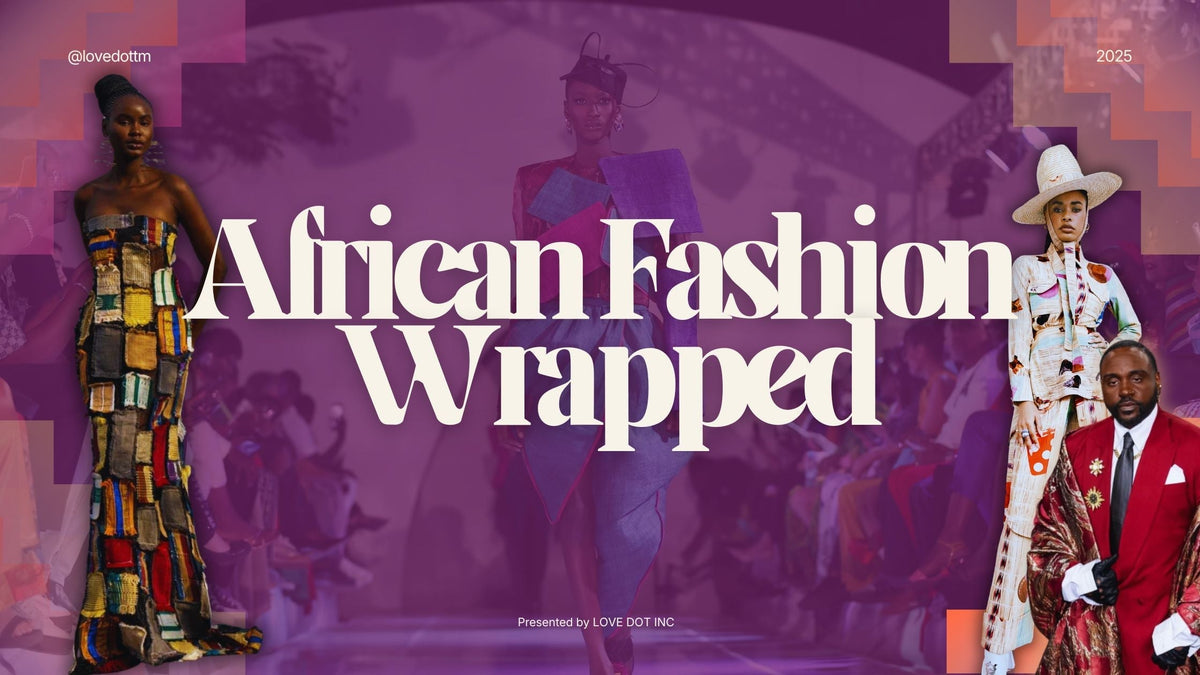

Fashion Wrapped by LOVE DOT
2025 was supposed to be “another year of waiting our turn.”
Another year of watching European runways "discover" our textiles. Another year of seeing our patterns called "tribal" while tartan gets called "classic." Another year of sustainable fashion meaning beige minimalism while our bold, handcrafted maximalism gets labeled "too much."
But something shifted.
In February, someone gave it a name: Afrothencity—the authentic embrace of African culture. And suddenly, what we'd been building in studios from Chicago to Accra, what we'd been stitching in small batches while the fashion world debated whether ethics could ever be exciting, finally had language.
The word felt both overdue and perfectly timed.
The Year Everything Changed
Tyla sat front row next to Anna Wintour at Paris Fashion Week. Not as inspiration. As power.
The Met Gala dedicated its entire exhibition to Black designers for the first time in history. Superfine: Tailoring Black Style raised $31 million and told the world what we already knew: for us, clothing has never been frivolous. It's been armor, identity, resistance.
Lagos Fashion Week won the Earthshot Prize—one of the planet's biggest environmental awards. Read that again. Lagos. Fashion. Week.
Africa Fashion Up received 300 applications, up from 200 the year before. One hundred more designers saying: I'm ready. I belong here.
South Africa's Durban July became a celebration of Marvels of Mzansi—baobab-inspired gowns, Blue Crane feathers, fashion as reclamation and joy.
The numbers backed it up: Africa's fashion market hit $6.53 billion, projected to reach $8.86 billion by 2029. UNESCO estimates the continent's fashion exports at $15.5 billion annually, expected to triple within a decade.
But here's what the numbers don't capture: the pride. The reclamation. The joy of being represented not as exotic, but as simply worthy.
What Afrothencity Actually Means
It means designers stopped making African fashion "palatable" for Western consumption. They started making African fashion, period. The world learned to appreciate it on its own terms.
It means sustainability became spectacular. Bold cherry reds, deep blues, bright yellows. Exaggerated silhouettes and intricate layering. Maximalism that refuses to apologize.
It means handwoven textiles, natural dyes, organic cotton, and upcycled materials became standard, not exception.
For too long, we were told sustainable fashion had to whisper. African designers said: No. We make fashion that claims space.
Why LOVE DOT Exists in This Moment
We've been living Afrothencity since before it had a name.
Every piece handcrafted with artisans from Johannesburg to Accra. Every collection batch-produced in limited stock. Every scrap of excess fabric transformed into wallets and head-ties instead of landfill. Raw textiles from independent Ghanaian and Togolese farmers. Beads from across South Africa.
This isn't marketing. This is mission.
We don't make clothes, we help ambitious men and women own the moment.
If you're reading this, you're already part of that community.
There's So Much More to This Story
This is just a glimpse. The complete article dives deeper into:
-
The designers redefining African fashion from the inside out
-
How language shapes reality (and why "Afrothencity" changes everything)
-
The numbers that prove African fashion is a $6.53 billion market projected to hit $8.86 billion by 2029
-
Why the Met Gala's theme was about what we've always known
-
The infrastructure being built that allows hundreds of designers to thrive
-
Personal reflections on building LOVE DOT as a love letter to heritage and rebellion
Get the full story here and join the LOVE DOT community for everything bold and fabulous in African fashion.
This movement has been decades in the making. It's only now getting started.
And you weren't born to blend in.